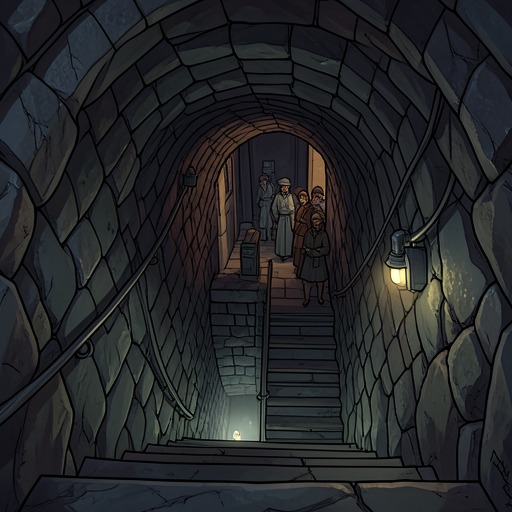
The Battle of the Paris Catacombs
World War ZThe Battle of the Paris Catacombs was a subterranean campaign in which French forces confronted the living dead inside the tunnels, ossuaries, quarries, utilities, and wartime passages beneath Paris. It became both a military ordeal and a national myth: a place where darkness, toxic air, unreliable maps, and acoustics that made every scream directionless turned combat into a struggle against the environment as much as against the zombies. Its decisive significance lies in the contradiction at its center. The operation produced a shining moment of national pride, yet it also killed or lost fifteen thousand people in only three months, when a slower campaign might have preserved far more lives.
Setting and Strategic Background
Andre Renard presents the underground war from Quebec, where he has withdrawn from public life after the official end of hostilities in western Europe. He rejects the boast that any other campaign was harder, especially the familiar claims made for mountain, jungle, or urban warfare. In his view, fighting beneath a city was categorically different. The Paris aboveground skyline had long been kept relatively low not only for reasons of aesthetics and civic continuity, but because the ground beneath the city was extensively tunneled and could not safely support a forest of modern skyscrapers.
The subterranean network was not a single battlefield. It included Roman tombs, limestone quarries, World War II bunkers associated with the Resistance, Metro lines, telephone conduits, gas mains, water pipes, and the catacombs themselves. The catacombs held approximately six million bodies transferred from overcrowded prerevolutionary cemeteries. Their walls of skulls and bones, sometimes arranged in patterns and sometimes used structurally to retain loose remains, made the dead part of the architecture before the zombies ever entered the battle. The setting therefore collapsed distinctions between cemetery, infrastructure, refuge, and military objective.
During the Great Panic, civilians without organized survival guidance moved into this world because of the belief that it was safe underground. Later estimates placed the number of refugees at roughly two hundred and fifty thousand. Renard does not condemn them for entering. They lacked the civilian survival manual and Radio Free Earth, and the movement seems to have grown by rumor: one group found shelter, others followed, and the underground population expanded without adequate food, tools, entrance control, or reliable screening for infection. The resulting mass of unprepared survivors became part of the campaign's human background and its moral burden.
Conditions of Combat
The battlefield defeated ordinary military perception. Prewar maps did not show the tunnels, alcoves, survivor-made connections, or sudden holes in the floor that had developed by the time of the operation. Soldiers could lose their way at least once a day, sometimes more often. Recovery meant tracing a communications wire backward, checking the old map, and attempting to determine where the route had diverged. A detour that seemed to last minutes could consume hours or days.
Visibility and communication were equally precarious. A platoon might possess only one pair of night-vision goggles, if it was lucky, while batteries for electric torches were scarce. Sometimes a squad had only one working light, carried by the point man, its red-coated beam cutting a narrow path through the dark. The air was poisonous with sewage, chemicals, and rotting flesh. Many gas-mask filters had expired, so troops used obsolete military equipment or firefighting hoods that caused their own difficulties: they made soldiers sweat, muffled sound, and restricted both sight and hearing.
Radio transmission could not be trusted underground. Units therefore relied on hardwired sets connected by old copper telephone wire, which soldiers stripped from conduits and carried in massive rolls to extend their range. The wire was more than a communications device. It was a lifeline and, often, the only means by which a unit could find its way home. Yet even with it, the tunnels produced a uniquely cruel uncertainty. Cries from an attacked squad could arrive over the radio or echo through the passages, while the acoustics made screams and moans seem to come from every direction. A rescuing unit might sprint, strike its head on the ceiling, crawl on hands and knees, and reach an empty chamber, only to discover that the calls for help remained far away.
Flooding added another layer of danger. When troops encountered submerged passages, commanders sometimes withdrew to a defensive position and waited for the Cousteaus, divers trained to fight in the flooded tunnels. Equipped, when fortunate, with a searchlight and a shark suit, and limited to at most two hours of air, the divers were expected to use safety lines, although many refused because the lines tangled and slowed them. Their survival chance was estimated at one in twenty, the lowest ratio of any branch of any army, and their automatic receipt of the Legion of Honor reflects the scale of the risk rather than a ceremonial excess.
The Campaign and the Hospital Stand
The underground operation consumed the entire core force. Fifteen thousand people—both Cousteaus and other troops—were dead or missing after three months. The losses were especially bitter because the broader war was already winding down. Renard contrasts Paris with London, which was cleared gradually, one section at a time, over years and with a low-speed, low-intensity, low-casualty method. Paris instead became a demand for speed and spectacle, a decision he associates with the need for heroes and with the public desire to recover confidence after earlier national disasters.
The campaign's celebrated locations included the Ossuary, Port-Mahon Quarry, and the Hospital. The Hospital became the defining episode. According to the legend Renard recounts, the Nazis had built it to house mental patients and allowed them to starve behind concrete walls. During the Zombie War, it served first as an infirmary for the recently bitten. As reanimation spread and the survivors' humanity seemed to fade with their electric lamps, the infected—and possibly others who were merely suspected or unwanted—were thrown into the underground vault.
An advance team broke through without knowing what waited beyond the breach. The soldiers could have withdrawn, destroyed the tunnel, and sealed the undead inside again, but instead one squad faced approximately three hundred zombies. The squad was led by Renard's younger brother. His voice was the last sound the force received before the radio went silent, ending with the final declaration, “On ne passe pas!” The phrase, fixed in the account as “They shall not pass,” turns the brother's death into a national emblem of resistance while preserving the immediate horror of a unit isolated in an underground vault.
Logistics and the Wider War
The catacomb campaign is framed by a larger military lesson: victory against the living dead depended less on traditional generalship than on the ability to manufacture, supply, and transport effective materiel. The Allies had won World War II through industrial output, natural resources, and logistics; in the Zombie War, the survivors occupied the position of the Axis. The living dead controlled most of the world's landmass, while American war production was restricted largely to what could be harvested in the western states. Refugee-packed merchant ships and fuel shortages further constrained transport and naval operations.
That lesson shaped the weapons and doctrines available to forces fighting the zombies. The resource-to-kill ratio became a governing principle after Travis D’Ambrosia became chairman of the Joint Chiefs. It favored systems that could achieve reliable kills without consuming resources needed elsewhere. The Continental Airlift applied the same logic to isolated Red Zones and Blue Zones, coordinating demands, procurement, prioritization, and drops on a scale described as the largest undertaking in air force history. Rather than relying on endless deliveries of food and medicine, planners preferred self-sustaining drops containing tools, spare parts, and equipment for making spare parts, while still delivering fish, wheat, salt, dried vegetables, and baby formula during hard winters.
The same discipline exposed the folly of Project Yellow Jacket, which promised a theoretical victory within forty-eight hours through millions of satellite-guided micro-missiles aimed at zombie brains across North America. Its expense represented resources that could have produced more dependable tools. By contrast, the Standard Infantry Rifle was valued for reliability, accuracy, adaptability, and mass production, while Cherry PIE ammunition shattered inside a zombie's skull, destroyed the brain without spreading infected tissue, and reduced the need for wasteful burning or decapitation before burial. The Paris campaign demonstrates why such principles mattered: in a maze where every battery, filter, diver, wire roll, and trained specialist could determine whether a squad survived, heroic intensity could not substitute for sustainable logistics.
Consequences and Historical Meaning
Renard's account refuses to separate victory from the cost of obtaining it. The fifteen thousand dead or missing were not merely the price of defeating a uniquely difficult enemy; they were evidence that the campaign had been driven by a political and emotional need. France needed heroes, new names, and new places through which to restore its pride. The Hospital supplied exactly that kind of story: a small squad, an impossible numerical disadvantage, a legendary last stand, and a final refusal to yield. The emotional force of the episode helped convert a military disaster into a “shining moment.”
The battle also reveals how emergency societies turn sacrifice into discipline. Elsewhere in the war, governments used public punishment, labor, propaganda, and the promise of national survival to compel cooperation. The logic could be brutally practical: prisons consumed able-bodied citizens, while public shame could deter theft more cheaply and visibly than permanent incarceration. In another account, soldiers were forced into collective executions so that guilt, as well as fear, would bind them together. The Paris campaign belongs to the same moral landscape. Its dead became instruments of collective confidence, and its survivors inherited both pride and the knowledge that a different pace might have spared them.
For that reason, The Battle of the Paris Catacombs is not simply an underground action sequence. It is a study in how warfare changes when the enemy has no need to be bred, fed, or led, and when the physical world has become hostile to the institutions designed to control it. The campaign's tunnels erase the clear lines of conventional battle: maps become obsolete, communications become fragile, rescue becomes misdirection, and the dead occupy a space already built from human remains. Its final irony is that the operation's greatest legend—the Hospital and the younger brother's last transmission—stands beside its clearest indictment. Paris was remembered as a triumph because it created heroes, but its fifteen thousand casualties testify to the price of choosing glory over a slow and safe clearance.